The Winnipeg Jewish Theatre’s season opener, The Cut, prominently features a banana on the program cover. The half-peeled banana has had the end of it bitten off and serves as a not-so-subtle metaphor for the subject of Jordi Mand’s newest script – at least that imagery is what WJT uses to set audience expectations: this is a play about circumcision.
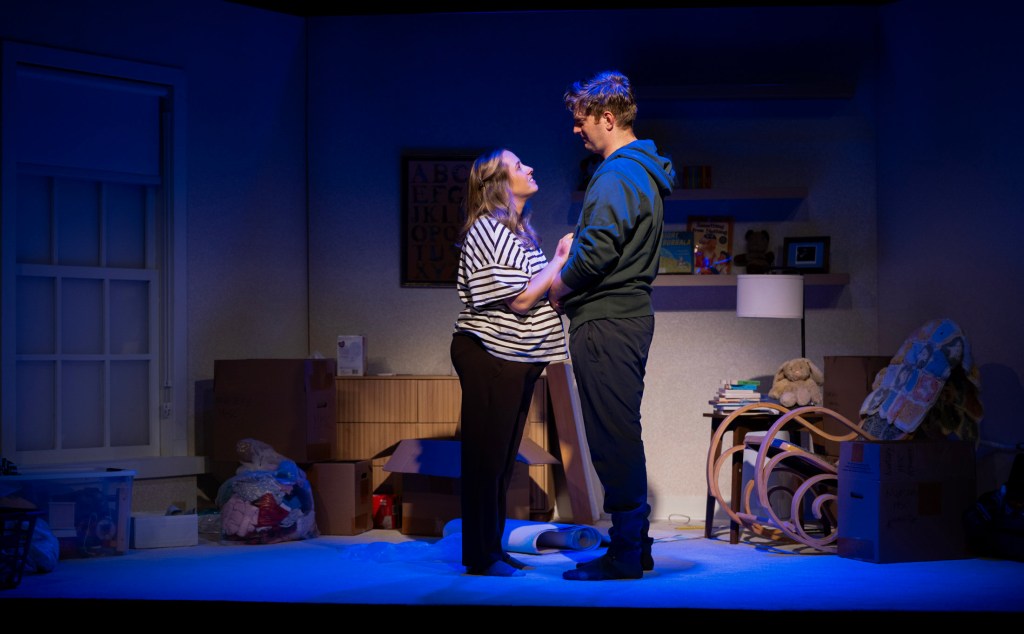
Together for 15 years, Sarah (Hallie Seline) and Andrew (Wade Bogert-O’Brien) have experienced significant change in the past year. She is seven months pregnant; he has received a diagnosis of a medical condition; and the play begins with the pair unpacking boxes in the nursery of their new home. This two-hander features affectionate, vulnerable, and comforting dialogue alongside friendly sparring (scissor versus scissors – which is correct anyway?) as the play naturalistically looks at how a young couple loves.
However, the conflict that WJT had audiences anticipate comes to the foreground: should their unborn son undergo circumcision? The debate surrounding this surgical procedure addresses how a duo can know each other so well while also coming from different backgrounds. Sarah identifies with the Jewish culture she was raised in, remaining close still to her parents, who have frequently denigrated her relationship with non-Jew Andrew. Cue a pair of grounded performances from the actors as they examine their characters’ dissimilar perspectives surrounding religious rituals, bodily autonomy, community and conformity, and revisiting romantic regrets and old wounds.
The script jumps to a few days later partway through. The debate shifts from speaking less in hypotheticals and more to the language of moving forward. To represent the shift, lighting designer Larry Isacoff and sound designer Ashley Au create a colourful montage that impressed me with their skills while still feeling a touch long – possibly just to cover the costume change – in this hopeful human drama.
There are moments that feel underwritten (Andrew’s diagnosis and the emotions around it) and there are some that are overwritten (the fantasy duet about their hopes for the baby) but The Cut generally finds a good balance. The direction of Brendan McMurtry-Howlett helps this 80 minute play flow smoothly and feel as if the wall was taken off the nursery for us to observe these intimate moments between Sarah and Andrew. I suspect most performances will have at least a few nodding heads and chuckles of recognition from the audience.
Reading the playwright Jordi Mand’s program note preshow, I found myself thinking further about it after the performance. Mand points out that this is not a play about circumcision. I mean obviously it is but she’s right – it’s about more than that, it’s about a couple who “love each other deeply and discover that love doesn’t erase the differences between them” (Mand). Rather than being an issue play, this is a piece about their relationship. I wonder if more minimalist design and promotion might focus the attention on the characters more but I’ll find out the next time this solid world premiere receives a production.
***************************
Christopher Douglas (he/him) has primarily been a producer or stage manager. He has worked on 40+ productions in a variety of venues including parks, a bed-and-breakfast, a former coffin factory, and on a literal island. His short plays and adaptations have been performed in academic and festival settings and he is currently exploring poetry and libretti. He has (very) occasionally been convinced to act. As a reader, he devours award-nominated scripts and, as a critic, he has a history of being outspoken. A Torontonian by birth and a graduate of York University, he now lives in Winnipeg.
Veux-tu lire en français? Aller au Place au Théâtre Winnipeg
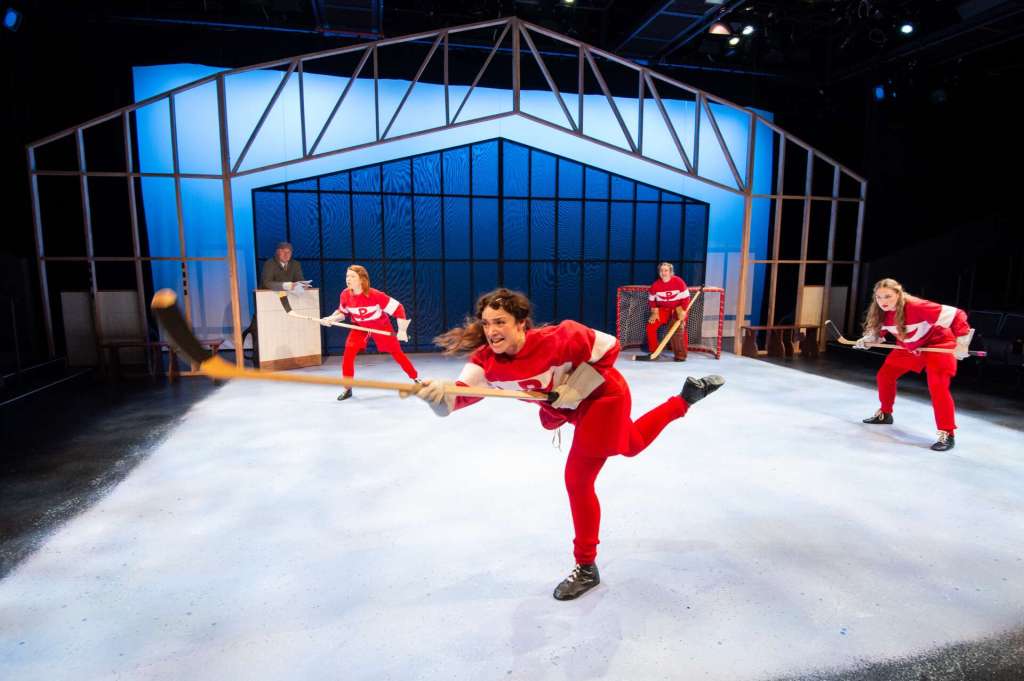
Based on the true story of the Preston Rivulettes, who won an astounding 350 games during their tenure (Canadian Encyclopedia), Prairie Theatre Exchange’s Glory transforms the Cherry Karpyshin mainstage into a hockey rink to showcase how our heroines made their way from Depression-era softballers to national champions. We meet our starting lineup during a softball game against their rivals, the Port Dover Sailorettes, before they decide to stay active during the winter season and break ground as a women’s hockey team. We then follow the Rivulettes from their inaugural season all the way up to being Olympic hopefuls.
Led by Hilda Ranscombe (Cora Matheson), the team consists of sister Nellie Ranscombe (Emily Meadows) and the team’s second pair of siblings, Marm and Helen Schmuck (Jada Rifkin and Katie Welham respectively.) Cory Wojcik is reluctant coach Herb Fach, who acts as the face of period-accurate sexism as our players fight to prove themselves on the ice. Our unseen announcers (played by Gord Tanner and Wayne Buss) help out in this regard as well. Both throw out some truly boorish comments about femininity as our players batter their opponents. Rest assured, these ‘little ladies’ are here to throw elbows and foul just as hard as the boys. Even harder, given we see multiple penalties, a missing tooth, and an all-out Donnybrook by play’s end.
The set remains sparse throughout, dominated by the ‘ice’ with a net and a few choice pieces helping orient us between the different games, shoe factory, train, and change rooms. The makeshift ‘boards’ have a nice, worn-in look that speak to game after game of players getting battered into the wood. Likewise, Victoria Exconde’s choreography places us into the world of the games. No roller skates here; our players glide across the floor with jazz shoes and balletic grace. The choreography, from slapshots to pirouettes, pair nicely with Joseph Aragon’s original score of upbeat jazz. The commitment to the faux-skating is great throughout, including some wonderful physical comedy from Emily Meadows as she does her best Bambi impression. The games do get a bit repetitive throughout, especially with unseen foes battling it out on the ice, but the difference in staging helps orient us along the Rivulettes’ journey to the finals.
The script is also a tad uneven from a pacing perspective – the Rivulettes go through all the major beats of your standard sports underdog story in the first act, from forming the team through a training montage culminating in the 1933 Dominion Title championships. We then join the team in Act II after a five-season time skip and blaze through the team’s journey to a European tournament before a stark reminder of just what year we’re in rears its ugly head. If the play feels at all anticlimactic, there’s only history to blame.
The play is far from hopeless however. Glory is a charming start to Prairie Theatre Exchange’s season, taking audiences on a tour of Canadian history and wins for gender equality in our nation’s favourite pastime. Despite the collar-tugging comments about the future of women in sports (it would be ninety years after the Rivulettes first hit the ice for Canada to get a professional women’s hockey league), the audience roots for our players until the very end.
Daphne (she/her) is a director and creator based in Winnipeg. She is a graduate of the University of Manitoba with a BA in Theatre and Film Studies. In 2022, she graduated with honours from the inaugural Red River College Digital Film and Media Production program. She has worked with companies like Royal Manitoba Theatre Centre, Prairie Theatre Exchange, The Village Conservatory for Music Theatre, The Keep Theatre, Theatre Projects Manitoba, and Rainbow Stage, in addition to running her own company, Hypothetical Projects. Daphne was the recipient of the inaugural Dan Augusta Promise Prize from Sick + Twisted Theatre and received the Gladys Cameron Watt Award in the 84th National One-Act Playwriting Competition.
Veux-tu lire en français? Aller au Place au Théâtre Winnipeg
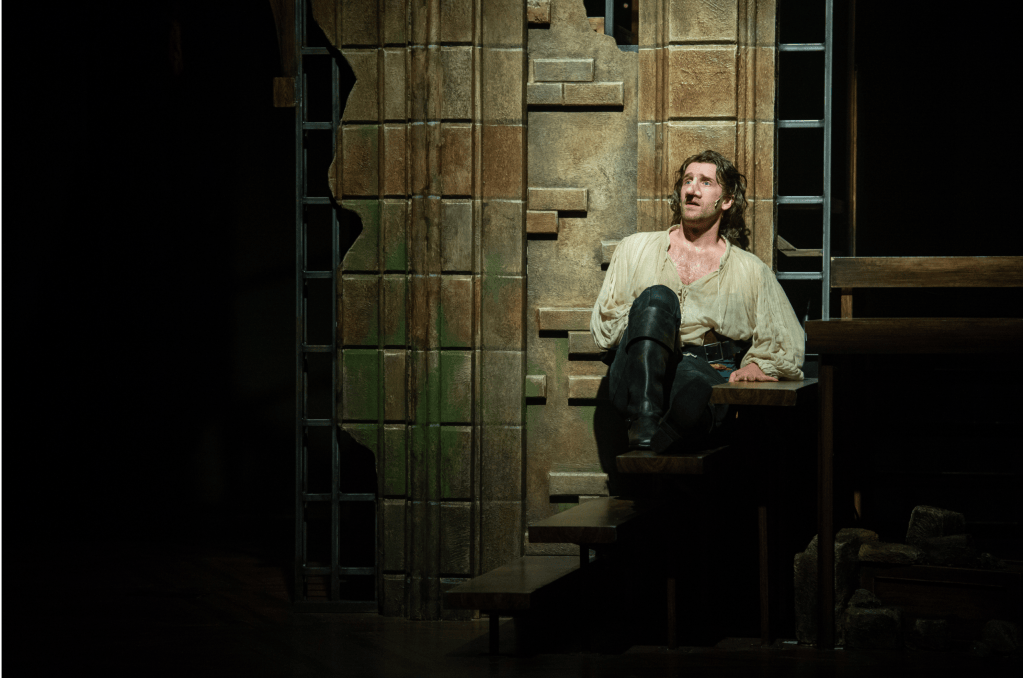
Jack Davidson in Cyrano de Bergerac, produced in partnership with Citadel Theatre and the Grand Theatre. Photo by Dylan Hewlett.
Jessy Ardern’s adaptation of Cyrano de Bergerac is a spin on a classic I didn’t know I needed. As a Deaf and Autistic theatre-goer, I found that I was viewing this work through a disability lens. Upon reading Rosand’s original play, Ardern described falling in love with Cyrano. She met a “ferociously funny, terrifyingly self-destructive man… whose defining characteristic is a consuming, unshakeable rage: at hypocrisy, at classism, at the barest hint of moral compromise.” This black-and-white thinking and strong sense of justice combine with Cyrano’s savantism to offer an Autistic-coded young man. It also causes problems for him as he is deeply in love with his childhood friend Roxanne and is unable to tell her. This parable about a man’s insecurity getting the best of him now has a relateable origin in the unending trauma that accompanies growing up different (read: neurodivergent).
The play’s opening throws us in head-first to an experience that is momentarily overstimulating. After a minute, having acclimated to the rhythms of this world, we are transported to the world of 17th century Paris. This production of Cyrano de Bergerac is sensory joy; it glimmers. Director Amanda Goldberg utilizes the balconies at MTC’s John Hirsch stage so that ee, the audience, have been written into first scene . Elaborately garbed onlookers heckle the actor Lignière, spotlit in embroidered, flowing pants. His repartee with Cyrano gives way to the titular character introducing himself, neuroses-forward.
Cyrano confesses to loving Roxanne to a friend but not to her. This inability to directly express his feelings could be informed by several factors: a desire to do what is logical, even to one’s own detriment; emotional alexithymia (intense difficulty recognizing and processing one’s own emotions); a reluctance to embrace the change in a relationship – how would he have to adjust to the expectations on Roxane’s lover, after living so comfortably as best friends?
Immediately upon meeting Stephanie Sy as Roxane, her incandescence is apparent. Far from the two-dimensional Roxane of yore, this lively, self-empowered woman captivates the viewer along with Cyrano, Christian, and de Guiche. As the classic web of romantic deceit is spun, this town’s culture is depicted as secondary characters are presented in situ. When the boys of Gascogne burst on to the stage to heavy, trap-inspired beats, their camaraderie and boisterous energy are infectious. Several narrative strands are interwoven as we shift from listening in on conversations between Christian and Cyrano, Roxane and Marie, and as we watch Comte de Guise’s contortions under his scheming. Brian Hammam’s performance as an antihero was riveting; his demeanour, dress, and movements gave a superverbal description of his moral arc.
While watching Cyrano channel his otherwordly gift of poetry only to benefit his friends can be a head-scratcher, viewing him as Autistic with profound Rejection Sensitivity Dysphoria might explain his behaviour. He knows that romantic love is possible, and he recognizes it in Roxane and Christian, but 21 years of endless othering within his community have left him psychologically broken. Jack Davidson’s Cyrano is an intriguing enigma, as he alternates between assurance, when engaged in either of his special interests, and a hapless, walking mental breakdown in most other contexts. Cyrano has identified himself as a facilitator, a helper, and above all, a good friend. Watching this absurdly talented man torture himself is perversely exquisite.
For his part, Christian’s asymmetrical scattering of skills could suggest a learning disability and/or communication difference. His bumbling efforts to craft even a single rhyme set him apart from his peers, and we quietly cheered him on as he demonstrated a sincerity usually beaten out of a person before they reach adulthood. His conspiracy with Cyrano is unquestionably problematic, and yet his pure heart shines through. He really does feel all those things his friend writes for him, but he would never be able to express them. When Christian has a breakthrough and reflects on the way he shows up in society, hindered by his perceived intellectual inferiority, we are invited to muse on how things might have turned out differently for him, if he’d had educational supports. Everyone knows a kid who skated by through school, copying friend’s work and masking dyslexia. Neither Cyrano nor Christian are physically or intellectually disabled, but their differences have resulted in them being Othered by society.
In a pivotal scene, atop rickety stairs in a bedroom perpetually lit by a full moon, Roxane pines. Her sharp with and passion for wordplay set her apart from her peers. It’s not just romance she longs for, but to be understood. She’s too smart, too spirited and wilful to fit in to the narrow niche women are given. She finds workarounds to the omnipresent threat of misogyny generally, and specifically evades the malevolent intentions of specific men by thinking outside the box. In Ardern’s rewrite, Roxane’s naïveté is earned. Every time she spots a red flag, her quick-thinking best friend is able to gaslight her anew.
Finally finding a mind that’s on her wavelength, that can keep up with her hyperlexia, feels like everything has fallen into place. Roxane, being seen by the letter-writer, experiences a deep sense of belonging along with intellectual stimulation. Gifted children often spend much of their time alone, unable to align with their peers, and often act out destructively, or develop neuroses. Social morés around gender norms (especially then!) would have prevented her from enjoying much time with Cyrano during their teen years, as well as confined such a brilliant girl academically, socially, and psychologically.
Between the simple sets and resplendent costumes, the evocative music and fresh “verse-ish” flowing rhythmically between actors, this telling breathes new life into an old tale. Touches like the graffiti in the pub, layered shadows, and letters strewn about in the chaos of war made the stage ripple with meaning. Ardern’s nuanced writing highlighting (finally!) strong female characters and the deep-seated insecurity at the core of humanity.
Veux-tu lire en français? Aller au Place au Théâtre Winnipeg
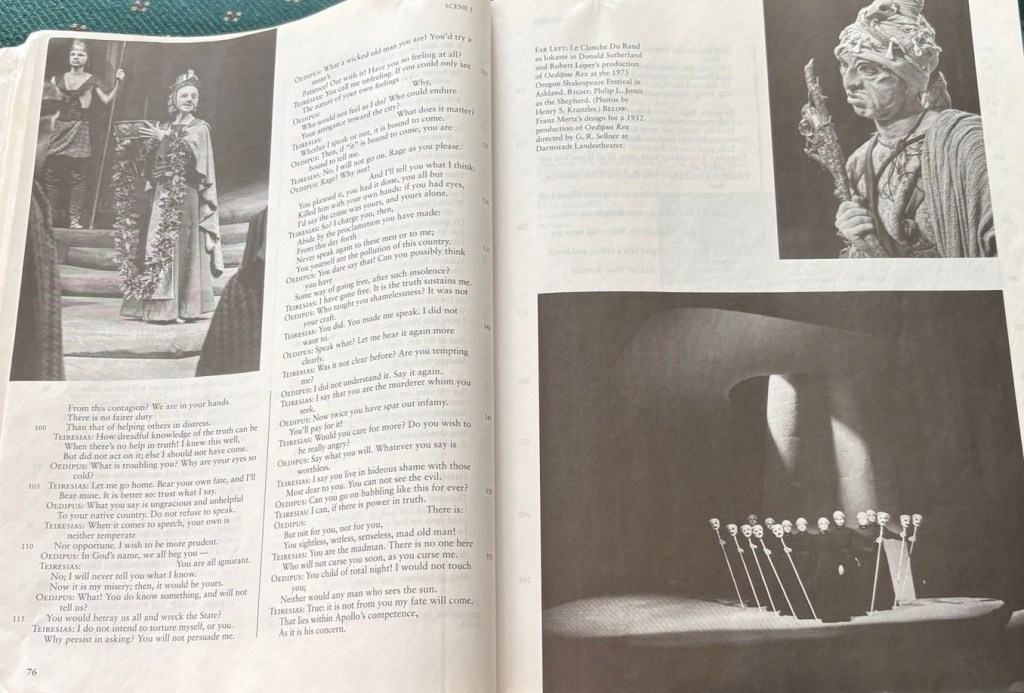
There are plays you read because the plot is compelling and you want to find out what happens. This is not one of those plays. What’s interesting is that this textbook explains that the Ancient Greeks also came to this play knowing the characters, the story it was based on, and what was going to happen at the end. So much of the time Western storytelling focuses on the surprise ending, the big shock and awe. When you read plays like this you have to adjust your expectations. Instead of focusing on what will happen, the emphasis is on how you get there. What goes into the unraveling of plot. This is something I have to remember is an option when I write: there are many ways to capture tension, and if you do it properly your work can be enjoyed multiple times.
Most people, including those who aren’t much for Greek mythology, are aware that Oedipus is the guy they named the complex for. In the off chance you don’t know more than that, here is the summary: as a baby a prophecy is made that prince Oedipus of Thebes will kill his father, the king, and marry his mother Jocasta the queen. Since this is pretty unacceptable for everyone involved, his doting parents leave him to die on the side of the road, because apparently infanticide seems to have been pretty acceptable in ancient Greece. As it happens, a poor shepherd couple find Oedipus and raise him as their own. He finds out about the prophecy and leaves to save his parents. Along the way to Thebes he comes across an old guy who he kills on the road. Oops. Then he stumbles across the Sphynx who has been asking people a riddle and killing them when they’re wrong. He, however, gets it right and is crowned king of Thebes, also accepting their offer to marry the king’s widow. Then at some point there is a blight on the land and wise sages say that the misfortune is happening because the old king’s murderer has not been punished. That’s where the play starts.
It’s always a little strange to talk about Greek theatre because they often require background knowledge and readings. When Oedipus Rex starts we as the audience understand intrinsically that this man is doomed, as we follow his righteous investigation into the death of the kind. For me, what stands out in this play is the tension between Oedipus’ self-righteousness and the doom we all know is coming. By all metrics, it doesn’t seem like he’s a bad king. At the beginning he’s energetically seeking out advisors and prophets alike looking for evidence. It has the feel of a detective show to be honest, with him setting out to find the truth at all cost. At the same time, so many people tell him to turn away, that nothing is going to come out that will be worth him knowing. He turns away priests for being unhelpful. He is insistent on chasing down people who were there at the king’s murder so long ago. He is trying so hard, and the closer he gets the deeper in it he is. When he finds out the truth he gouges out his eyes and goes to wander the earth, leaving the king’s brother Kreon in charge. Next entry is about him.
To be this is the classical example of a tragedy in the truest theatrical sense of the word. You have Oedipus who wants nothing more than to do the right thing all the way through his life… and yet he ends up in the same doomed place. I wonder as I read this text how he was as a son to his adopted parents. Clearly he loved them enough to try to avoid killing them. He defeated the monster who was terrorizing a population only to be the source of their distress down the road. He married this woman, had four children with her, consulted with her… and it turns out it was incest all along, one of the only universal taboos out there. From the perspective of intent, none of this is the work of an objectionable mind who is trying to deliberately cause harm. It’s someone who circumstances twisted out of shape. At the end, Oedipus feels that the only thing he can do is blind himself, and that’s what he does. So much suffering, and so little of it can be attributed to maliciousness.
As a former anthropology student, I feel like this is partially supposed to be a parable about the importance of tracking genealogy. Or the dangers of infanticide, that is another big issue. Regardless, keep track of relatedness. There is a reason why old epic poems often dedicate pages and pages to who descended from whom. Even if they aren’t always fun to read.
This play is an object lesson in building tension. Even reading it I can feel the horror as that ambiguity at the centre of the story is revealed. I want to create characters as morally complicated as Oedipus Rex without rewriting the story. How do you make the reader feel for someone who is doomed? Where do you go next?
I just don’t know.
Veux-tu lire en français? Aller au Place au Théâtre Winnipeg
Here to discuss Jordan at MTYP, we have siblings Eli (11)(he-him) and William (13)(he-him). For this time we are going to stick to the questionnaire format in which I record their answers with the questions. I’m open to changing it as the season continues though! Also remember that the questionnaire is attached below. We’re always happy to post more children’s reviews!
Do you like theatre?
Eli: Yes, I do!
William: Yeah
Why? Why not?
Eli: I find it fun and imaginative. It gives me a fun connection to my interests and everything that looks cool and visual and other effect. All the effects are really cool.
William: I have a lot of good times whenever we go to see it
What else do you like/not like in life?
William: I mean I in general enjoy science
Have you seen a lot of theatre?
Eli: Yes, I would say that I have
William: Yeah
What was your favourite?
Eli: Uh, Narnia!
William: Narnia! It was objectively a really good play
What did you see today?
Eli: We saw Jordan
William: Theatre on the Jordan principle
Tell me what the stage was like.
Eli: It had a bunch of things that kind of looked like birch trees. When I first got there I thought they were bamboo for a second
William: It was very clearly based on a birch forest but it also had drawers and they would put like other stuff on it
What did you think was going to happen before the play started?
Eli: I don’t know, but I definitely wasn’t expecting it to be about the Jordan’s principle
William: I didn’t really know much… but I knew it would be about someone named Jordan, presumably a kid.
What happened in the play?
Eli: Jordan, accompanied by a spirit bear, adventured around and met a bunch of people that were having trouble, and eventually went into the city to meet Cindy
What was the most exciting part?
Eli: I’d say when Jordan actually met Cindy cause it was the most interesting – it was the most exciting part!
William: I wouldn’t say that it was full of excitement. It was more mellow…and a learning experience… so I wouldn’t say that there is a most exciting part.
Tell me about the characters. How would you describe them?
Eli: Jordan seems quite childish because he is still a baby.
William: Jordan is very happy but kind of sad and Maskwa was like a guide
Did you like the characters?
Eli: Yes, I did. I liked the variety of characters and how each had their own personality. Sometimes with an inexperienced writer all of the characters act like what the writer would do instead of just what the character would do, and the characters really had their own personalities.
William: Yes.
Were you surprised by the ending?
Eli: I mean a little bit yeah. I was not really sure where the story was going,
William: I would say that the ending was surprising but I wouldn’t say that I was surprised at it.
What did you like about the play?
Eli: I did like the play. I did like the bear, he was really cool with the moving jaw.
William: It teaches a good lesson and I feel like it does exactly what it was designed for.
What didn’t you like about the play?
Eli: I always have a hard time with this one.
William: I don’t think that they did anything particularly bad, like I don’t like this part… I enjoy how they did it.
What did you think they could have done better?
Eli: They could have added a more variety of actors. One second, let me get my words in the way. When the same actor does the same thing twice I was like “Oh it’s them again’ and then it’s like “no, different person”
What was the best part of the play?
Eli: I’d say the pow wow
William: I do feel like when they met Cindy
Who do you think would like this play?
Eli: My auntie Alexa… Ezra and Micah maybe. I know that some of my teachers might like it, like my music teacher
William: Well my auntie Alexa and my two younger cousins… I do feel like some of the teachers at Wolseley (now Little Bluestem) would like it.
Would you see it again?
Eli: Yeah
William: Yeah!
How does it compare to other plays you’ve seen?
Eli: It’s not my favourite favourite but it’s a good play. I would say that it compares well. It’s not the lowest, it’s not the highest, it’s kind of upper…I knew about the Jordan’s Principle
William: I feel like it does pretty well
How would you rank it on a scale of “bad”, “not good”, “okay” “good” and “very good”?
Eli: Good
William: I’d say that it’s good!
Is there anything you would like to say about the piece?
Eli: No, I don’t think so
Veux-tu lire en français? Aller au Place au Théâtre Winnipeg
Eli. Photo shared with permission of her mother, Athena Kovacs.
We’ve all been there: a friend or a loved one has invited you to a show that they are obsessed with and you… don’t get it. Maybe the humour is off. It’s incredibly repetitive. The characters don’t speak to you. Yet somehow everyone in the audience but you is losing their minds over it. When someone asks you how the play was, do you go by your feelings or how happy it made the audience? How do you evaluate a play when you are not the intended audience?
Now imagine that the play is designed specifically for kids. Say, it’s a play at Manitoba Theatre for Young People. All of that weird humour and repetition that drove you crazy… is actually what they really love. If you ask your small friend they will tell you: The plot holes? Not a problem! The characters? Loveable! It was the best thing they’ve ever seen!
If at this point you step in with your grown up critical analysis and tell that child that the piece they loved is no better than mediocre, you are a terrible person. You are also committing a crime against theatre by dismissing its active magic spell on someone just discovering it. Also, and most importantly? You’re just plain wrong.
The thing is, that play was not for you. You as an adult are not the intended audience. You are a tourist, a visitor in an imaginative space that belongs to children. Putting your opinion above theirs in this situation is no better than going to a play in an unknown language and saying it was terrible because you didn’t understand it.
You’re missing the point. Calm. Down. Decenter yourself. Your opinion is not the one that matters here. Take a deep breath, turn around, and look at the small person you took to the theatre. They can help. Actually, they’d probably love to help you understand.
This is why on Curtains Up I have enlisted a Child Theatre Consultant. My main person is Eli, but I will shamelessly enlist any friends or siblings we can bring. Her job is to come with me and see the shows, because she is the audience that these shows are meant for. It has become a ritual. We meet at the theatre where her mom drops her off. We go in and chat about school and her friends, and sometimes what she thinks the play will be like. Then we watch the show. Afterwards, we go for hot chocolate and I ask her questions about the play and record her answers. Later, I learn that she tells the kids at school that she has a job as a theatre critic.
Now that I’m off reviewing, Eli and other child consultants will be doing the heavy lifting of the reviews for MTYP. It’s not what I usually do for reviews, but that’s the point. This is my attempt to find a way to get the perspective of the Intended Audience. That may mean it isn’t written in the same articulate sentences that might be used for adult reviews, but on the other hand this allows me to appreciate strengths that would otherwise go unnoticed.
Objectivity is a tricky thing. Personally, I’m not sure it’s the point where reviews are concerned. You have to be in the broad category of intended audience for the play to land. It also has to be possible for a critic to identify when they are not the intended audience, but hopefully communicate about the show in a way that is able to reach the people that are. Like conversations, not all words are meant for your ears. Just because you don’t understand what is being said doesn’t mean it doesn’t have value.
So this is why Eli gets paid in hot chocolate for her perspectives, and why I don’t feel qualified to review children’s theatre on my own. It’s also why I try to find a Metis friend for shows with Metis content, and am working to have French theatre reviewed by people who are francophone instead of basing their experience on subtitles. It all comes down to this issue of trying to respect who the words are for, being ok with not understanding everything about theatre, and allowing yourself to be informed by someone with that specific perspective. It’s about respecting that conversations go on without you all the time, but understanding that in art if you are patient and willing to listen… you might learn something
In the meantime, Eli and I are really excited about catching Jordan at MTYP this Friday. If a small person in your life would like to share their opinion, I have attached my survey to fill out using voice memo or paper. You are welcome to submit your small person’s perspective with the blog. Just let me know if you want a pseudonym and if it’s ok to share it online.
Hey theatre lovers, I’ve created a calendar of all the plays I could find. More shows will be added as long as they are 1) not a reading or workshop, 2) not a high school production, 3) Three nights or more. Feel free to send in your events!
Veux-tu lire en français? Aller au Place au Théâtre Winnipeg
In a second floor room without windows in downtown Winnipeg grows a tree. This tree’s deep roots remember Ovid’s ancient stories and, at the centre of a gallery in Artspace, its trunk can be located. Trees are a central image within Rafaella Marcus’ debut script, Sap, presented in this fluid staging by Elio Zarrillo. The audience seating is divided into quadrants spaced around a cylindrical shaft of translucent fabric – the tree’s trunk – at the core of the playing area. Actors move in and around the audience, creating a sense of intimacy (especially with a capacity of fewer than forty people) that echoes the script’s themes.
The sap flowing through the veins of this tree are the spoken words. In a steady stream addressed to the audience, the play’s nameless protagonist (Hera Nalam) guides us through her leafy hallucinations, her everyday life working at a women’s charity, and a lunch that introduces her to a lawyer referred to as ‘that guy’. The script’s humour shines through when that guy is described as being just what you imagine when you think of ‘that guy’ who would wink at you while scrolling Tinder, Bumble and Hinge simultaneously. Nalam lands these punchlines with aplomb before steering bravely back to the story.
Sex and danger and vulnerability crack through the tree’s bark when the pair meet again. The edgy sexuality of the show is discussed and frequently abstracted in the staging, but its visceral nature merits the warning the company offers.
The ground shifts when our protagonist then mentions her bisexuality. She seems content with it but not confident enough to tell everyone. Post-interaction with ‘that guy’, the lead sets out to a club and locks eyes with her ‘wonder woman’. A new relationship is forged, where our lead does not speak of her history with men. Of course, secrets come with consequences and inhibit growth.
The other characters in our protagonist’s greenhouse are played by Liz Whitbread, using swagger for ‘that guy’ and a sensual nonchalance for ‘wonder woman’ or a great bit of vocal fry for a receptionist at work. The playwright cleverly suggests this multitasking for the second actor and it pays off. Sap’s twists are logical in hindsight and can sometimes be anticipated as the script unfolds, but you will be kept wondering if they’re really going to go there before your jaw hits the forest floor when they do. The folks around me demonstrated the shock value of the show as they leaned forward, shifted, and gasped leading up to each reveal.
The heart of the tree resides in that fabric sheath where Grace Morningstar, dressed in shades of green, takes a seat with her gleaming red wooden cello. This production adds the element of live music, and borrows the very human sound of the cello to underscore our narrator’s thoughts and provide punctuational screeches or blats during conversational scenes. Also credited as composer, Morningstar uses a loop pedal to layer pulsating rhythms and melody to create its own commentary on the action.
At 100 minutes, the production could use some pruning, but the gentleness behind the major set change justifiably offers breathing room during a chaotic moment. However, when both actors speak while prone on the floor, they can be hard to see across the room. That said, in this verbose, modern script, the words are the Sap holding together the ideas and they can always be clearly heard.
******
Christopher Douglas (he/him) has primarily been a producer or stage manager. He has worked on 40+ productions in a variety of venues including parks, a bed-and-breakfast, a former coffin factory, and on a literal island. His short plays and adaptations have been performed in academic and festival settings and he is currently exploring poetry and libretti. He has (very) occasionally been convinced to act. As a reader, he devours award-nominated scripts and, as a critic, he has a history of being outspoken. A Torontonian by birth and a graduate of York University, he now lives in Winnipeg.
Veux-tu lire en français? Aller au Place au Théâtre Winnipeg
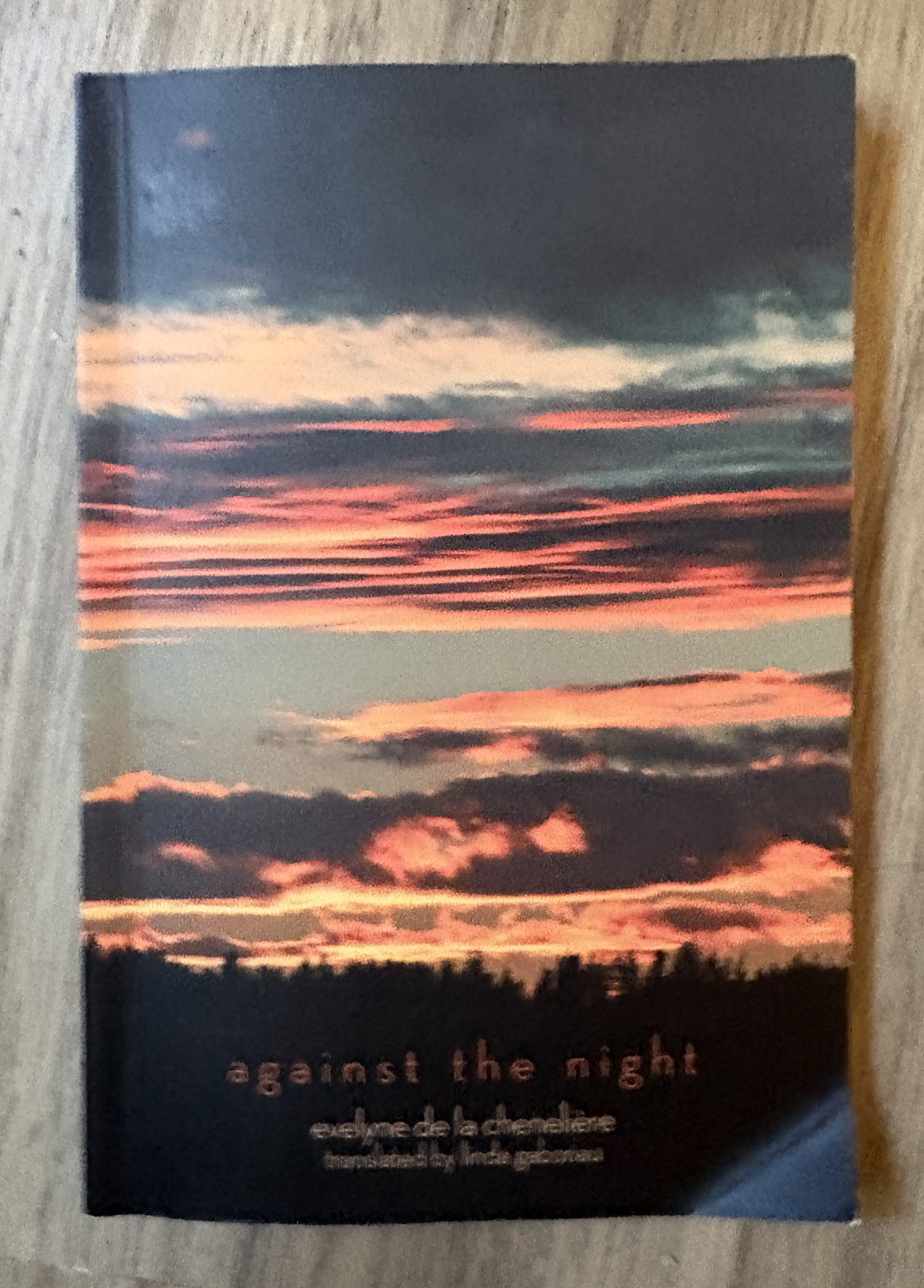
In the dark of night, perspectives are different. This is a key theme, not only of this book but of many works of fiction. Darkness and night are understood to stand in for the chaotic, the hidden, the place where people behave in ways that they wouldn’t were they subjected to the cold clear scrutiny of daylight logic. This key metaphor goes deep in many cultures, and it is finessed beautifully in this play by Evelyne de la Chenelière, a québécoise playwright who I will definitely be seeking more of.
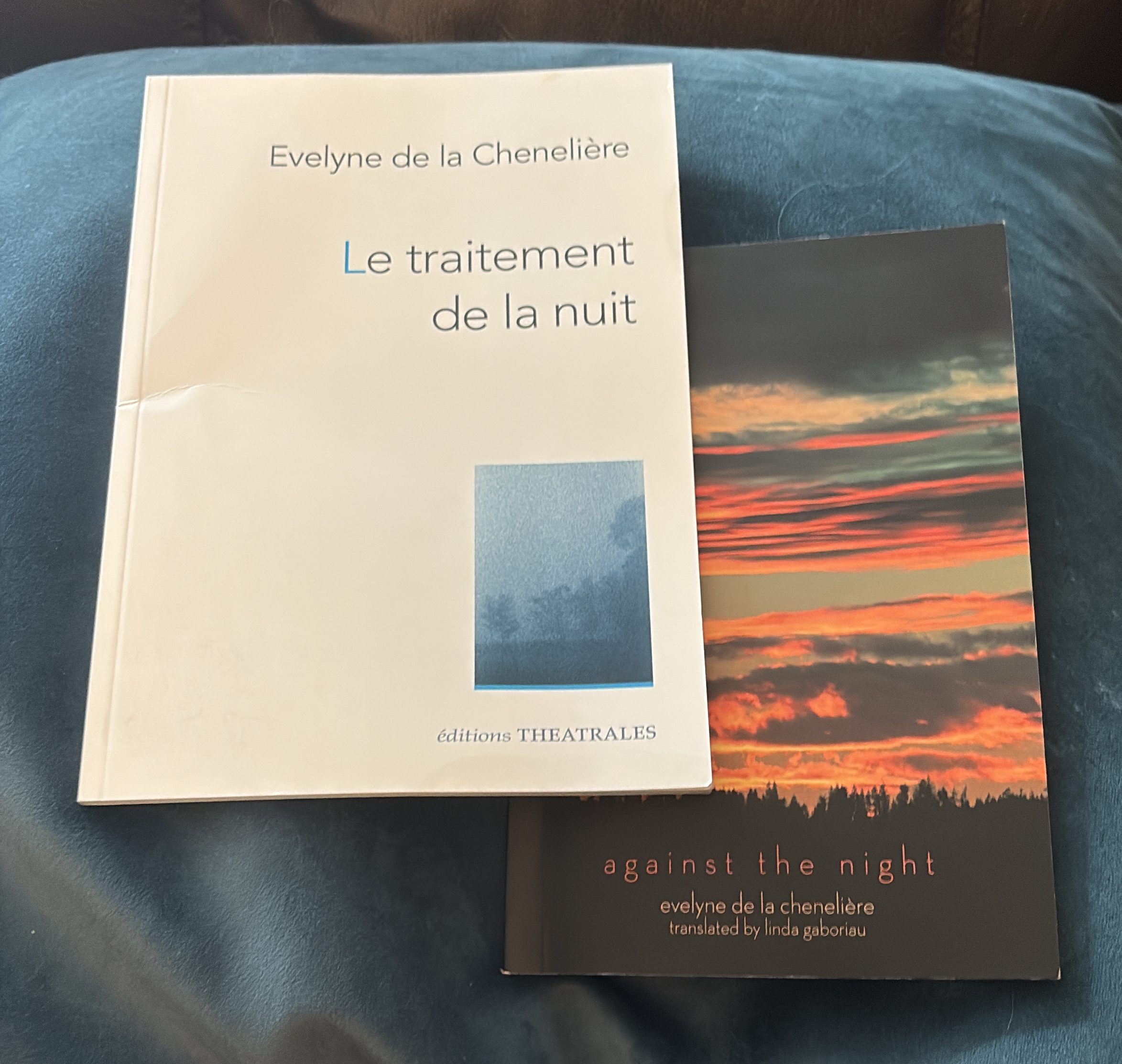
Speaking of perspectives, there was some language drama on my end with this text. I was given the English translation (thank you again Playwrights Canada Press), but the original is written in French, a language which I live, work, see theatre and write in. I have strong feelings about reading texts in the original language, so before I could review the translation I had to buy the original French play, Le traitement de la nuit and read it before I was willing to write a review. I don’t know if other multilingual people struggle with this issue as well, but I do. Which means that I can confidently say my review is informed not only by multiple readings, but also both in the original and the translation. I have given this play my time and my energy and feel entitled to make an analysis. Just so you know.
The story is full of ambiguity. We have Lena, the main character, who is the daughter of Bernard and Viviane, a wealthy couple who own an estate. The couple assure us that she was brought into the world with light and love and mutual cooperation in birth, but Lena makes it equally clear her life does not exhibit the happiness and joy her birth foretold. From the beginning, she is antagonistic to her parents who express themselves graciously, ceremonially avoid all conflict and bend over backwards to cater to her whims. In the mean time, Lena keeps running away from home, something they dismiss as “like a dog”. Their landscaper Jeremie, an ex-con, is paraded around as a sign of their magnanimous nature in front of their friends. That is until night falls, at which point Viviane swallows copious amounts of pills to deal with her insomnia and Bernard drives his Mercedes down dark roads. Lena and Jeremie are quickly complicit, sharing a garden shed as Jeremie hates houses. In the dark we finally see the cracks that their daytime pretences have caused and our vision of everyone becomes murkier and more complicated.
None of the characters are pure, that much is very clear, however what they are guilty of is difficult to determine in the script. It”s hard to reveal too much without giving spoilers, but I will say I tended to believe that Lena and Jeremie”s last scene did reflect a concrete truth. Viviane and Bernard are difficult characters to like, but equally hard to dismiss. They try hard to do positive things for struggling people, but there is a sense it is all performative. At the same time, their refusal to see their daughter Lena as she is, where she is and what she is, pushes Lena to further extremes away from them. There are so many choices to be made on the part of each actor and the collective productive how to approach this story.
The tricky part of this play for me, and the reason I read it so many times, is that there is so much mystery in terms of what is true and what is an illusion on the part of the characters. Their declarations contradict, erase each other, turn out to be dreams or illusions. Any director who takes on this script has big decisions to make as to what concretely has gone on because there are so many interpretations of concrete events. At one point I literally sat down and traced out all the possibilities of what could have been true and the number was staggering. Honestly, you could probably even play the whole thing as a “it was all a dream” Deus Ex Machina without difficulty.
The language is soft and lyrical, simple and elegant. The longer speeches make sense in context, and not a word is wasted. Everything builds to a crescendo of a strange, confusing, mixed up world with characters who can”t be bothered to see each other as they are. It’s a complex emotional landscape which is confusing and compelling.
As a concept I love everything about this book. As a reader, I found it incredibly unsatisfying. I feel like this would be better as a play infused with directorial decisions than lines on a page. I found myself trying to visualize casting this show, just to make sense of it, and playing around with different hints and allusions through set and costume choices. I think by some parameters that makes this a good script in that you want to transform it, but it also makes for incredibly frustrating reading.
This may be a case of learning to read plays in a different way than you read novels. I thought I knew a little about that distinction, but it turns out it is a process. I hope that as I keep reviewing I can start to develop techniques for understanding theatrical writing differently.
Thanks for reading!
Daniela Smith-Fernandez is Chilean-Canadian by birth, francophone by choice. She is an artist, writer and craftsperson who is proudly multicultural and multilingual (English, Spanish, French). She has worked in theatre as a costumer, prop maker, venue manager and volunteer. Her theatre reviews and articles have been published in student newspapers and blog. She is currently writing the second play in a trilogy about Jean-François, a man who is obsessed with sex and French grammar, not always in that order. She writes in English and French.
Veux-tu lire en français? Aller au Place au Théâtre Winnipeg
Confession time: I do not have a theatre degree. In order to compensate for this shameful lack on my part I am reading the Bedford Introduction to Drama from cover to cover in the interests of filling in the gaps of my knowledge. This feature will be interspersed with other pieces such as play reviews and topics in theatre. I hope you enjoy coming along on my journey to cram a theatre education into my brain with a 4th edition copy I acquired from someone second hand!
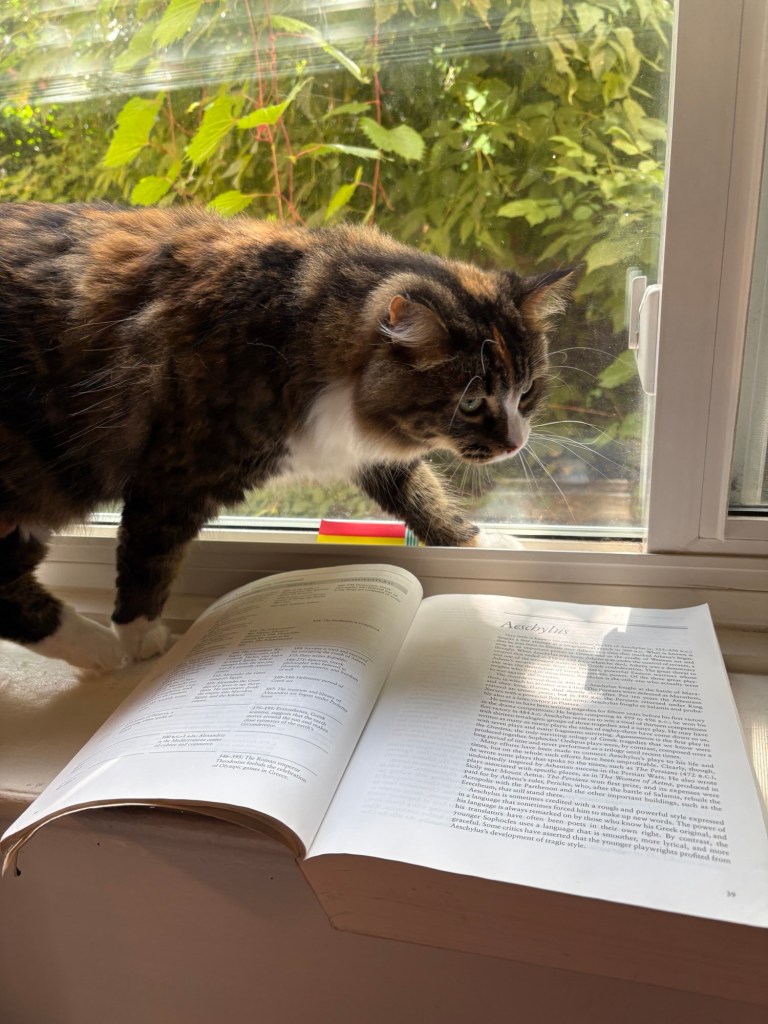
Greek theatre is one of the things my ADHD brain has hyper-fixated on over the years. It also happens to be the very beginning of Bedford Introduction to Drama, regardless which edition you look at. The fact the Western theatre tradition began with the Ancient Greeks is one of those generally uncontroversial statements everyone and their dog (or cat) make at some point when they write histories of the THE-A-TRE (grandiose voice absolutely required for correct pronunciation). I love it with the devotion of the eleven year old girl I was when it first crossed my path. My cat Noisette had a few things to say on the subject too, but she is also a very vocal lady who is mainly interested in telling me about how cool her cardboard box is. Anyways.
The first play in the book is Agamemnon by Aeschylus. Unlike other classics of Greek tragedy, I have absolutely no prior experience of this one. On the other hand, since it’s based on mythology, I did have the benefit of knowing the bones of the story. It is an offshoot of the Trojan War epics, so I apologize for the recap to those who can already tell you these stories in their sleep.
Ignore this if you choose to. You have Troy, a proud kingdom with a prince called Paris who isn’t good for much beyond appreciating pretty people. Literally – the goddess Aphrodite promises him the most beautiful woman in the world as his wife, never mind that said woman, Helen, happens to be married to King Menelaus of Sparta. Paris doesn’t care so they run off to Troy together. Then all of the Greek kings banded together to bring her back… or tried. Agamemnon, Menelaus’ brother was all set to sail off to war, except that he had angered a god and there were no winds. To appease the really awesome compassionate gods, he decides he needs to sacrifice his daughter Iphigenia, as you do (?) The Greeks get to Troy, demanding to get Helen back but Trojans refused… so they fought for ten years, during which time many things happen you can learn about with a decent Greek mythology textbook instead of depending on a theatre nerd recapping a textbook. When the play starts, Agamemnon has come back home after ten years away at war, and his wife Clytemnestra is still holding a grudge from him murdering their daughter. That’s where the audience comes in.
As a play Agamemnon has a different structure than other tragedies, particularly in relationship to what the audience knows. Here, Clytemnestra goes on and on about how happy she is to see her husband and what a good queen she has been. If you read this play at face value without the help of annotations, you are going to miss that EVERYONE seeing this play knows she is lying through her teeth unless the very last few speeches. This is where consuming art from another time and place gets so interesting – we’re faced with work that depended on the audience having familiarity with narratives that we probably don’t – or not unless we are Classics majors. It isn’t just what they knew, but also the degree to which these stories were internalized that can’t be recreated. We can’t recreate their cultural references. By its very nature, reading these texts is embarking in a complex translation project where we are forcing ancient stories into a contemporary framework. The question becomes: is it still worth reading these plays when there is inevitably so much we’ll get wrong?
I would argue that yes, there is still value. Translation is imperfect, but it is still invaluable in helping us appreciate that the world looks different from different angles.
In the beginning, the old men of Sparta are excited about their king coming home. Everyone goes on and on about what a perfect queen Clytemnestra has been, especially Clytemnestra. Then Agamemnon comes home with Cassandra, a former Trojan princess who is now a slave girl. Cassandra has ominous things to say about the future, but no one listens. Agamemnon takes a bath – at which point Clytemnestra kills him. Her lover then shows up and gloats like a cartoon villain about taking over the throne. Everyone calls for justice and just kingship, but that will take until the next play in the trilogy.
What struck me with this play was the distinctive nature of tension. Everybody knows what has and will happen, so what Aeschylus does is essentially freezes the story in one moment and digs deep into the ethical dilemmas at work. Agamemnon is a returning hero to the old men of Sparta, and those concerned with good state governance. On the other hand, he did this absolutely heinous thing by sacrificing his daughter, and no one denies that this was also terrible.
The trick is the balance between bad decisions, and breaking down the considerations. The murder of Agamemnon is horrific, but is it balanced out by the motivation of revenge? Clytemnestra took a lover while her husband was away, and so Agamemnon’s death now also means that the land is in the hands of a tyrant. How do you balance personal with social responsibility? I fight with these questions in every Greek tragedy, but more than usual with this one because of the fact Clytemnestra lies about her motivations. It’s really not about Agamemnon at all – it’s about the impact on Sparta the weight of his decisions have had. It’s about the space created by Agamemnon, not the man himself.
And as a playwright, how do you build tension when everyone knows what is going to happen? How do you make their speeches compelling on their own but also push forward the plot? What is the aesthetic value of having a chorus repeat lines together – do they speak for the collective, or are they intended to be special interest? I know that I love the ritualistic feel of Greek tragedy, the sense that you are going to spend the play deliberating on why things had to come about the way they did. It’s a meditation, a cry for justice. A conversation on what could have gone differently, and why things came to a point of inevitability.
At the end, Agamemnon is dead, killed in the bath. Iphigenia is long dead, killed by her father. Cassandra, princess of Troy and slavegirl of Agamemnon is also dead. Sparta is now controlled by a tyrant. And the question remains: was this inevitable, or the product of some seriously bad decisions? I want to consider that question in every play I read from here on in.
One of the interpretations I’ve read of the Iphigenia story comes from scholars Kenneth Atchity and Elizabeth Wayland Barber. To them, these myths of women came from a different cultural context, specifically a matrilineal society. These myths then got integrated into the artistic production of a patrilineal society that came and took over. This is where motivations are confusing. To them, the death of Iphigenia is unforgivable because according to matrilineal law she would have been Clytemnestra’s only heir. In other words, what her husband took away from wasn’t just a child but the continuance of her line. Which makes the death a political blow as well as a personal one. This does make sense in my reading of the play… but also your husband killing your child is objectively terrible and I think we can already ruminate on the whole situation without the use of my anthropology degrees.
I’m trying to go slow with this project, read plays one at a time. So far we’re up to a good start…
…as long as my cats grant me access to my textbook!
Daniela Smith-Fernandez is Chilean-Canadian by birth, francophone by choice. She is an artist, writer and craftsperson who is proudly multicultural and multilingual (English, Spanish, French). She has worked in theatre as a costumer, prop maker, venue manager and volunteer. Her theatre reviews and articles have been published in student newspapers and blog. She is currently writing the second play in a trilogy about a pansexual man who is obsessed with sex and French grammar, not always in that order. She writes in English and French.